The Finn Queen Of Comebacks
How Nooralotta Neziri lost almost everything, found her joy again, and learned to keep running when the track refused to cooperate.
There's a particular cruelty in the timing of what happened to Nooralotta Neziri on 8 September 2025.
It was the last hurdle rep of the last workout before the Finnish team's flight from their training camp in Chiba to the World Championships in Tokyo. She was in the best shape of her life. Six weeks earlier, in Espoo, she had broken her own 100m hurdles personal best — a record that had stood untouched for nine years — not once but twice in the same summer, finishing at 12.73. She had qualified for the World Championships for the first time in six years. She was, by her own quiet admission, ready to run times she'd dreamed about since she was a teenager.
And then, on that final rep, her right knee gave way.
If this were a story about misfortune, it would end there. But Nooralotta Neziri's story isn't about what happens to her. It's about what she chooses to do next.
The girl who started running by accident
She grew up in Kyläsaari, a small village on the edge of Pori on Finland's west coast. The Neziris had moved there in early childhood after a family accident — a car-and-moose collision on a Finnish road that left her mother permanently unable to work. The move was a reset. Her uncle, a former athlete, suggested she try the local running club, mostly so she could make friends in the new neighbourhood.
She was seven. She didn't know it then, but her life had just been redirected.
Nooralotta — daughter of a Finnish mother and a Macedonian-Albanian father, born in Turku on 9 November 1992 — was the kid who was a little bit different in every Finnish classroom she walked into. She decided early that this was a feature, not a bug. "I have always been a bit different," she would later tell an interviewer. "I've learned to like my difference."
By 16, she understood she might be one of the best junior hurdlers in the world. By the end of 2008, she was. She set Finnish junior records. She won the European Youth Olympic Festival. In 2011 she stood on top of a podium in Tallinn as European U20 champion. In 2013, in front of a home crowd in Tampere, she added a European U23 bronze.
In 2014 she became the first Finnish woman to ever run the 100m hurdles in under 13 seconds. In 2016 she stepped onto the start line of an Olympic semi-final in Rio. She still calls that her proudest moment.
She was 23 years old. The path was supposed to keep climbing.
It didn't.

The wilderness years
What followed was nearly a decade of starting and stopping. A 2017 season she had to abandon entirely because her body and mind couldn't keep up. A European Championship final she missed by a thousandth of a second.
- 2017A season abandoned. Body and mind both refused.
- 2018Berlin. Missed the European final by one thousandth of a second.
- 2021Stress fracture in the lower back during Olympic preparation.
- 2022Foot surgery. Achilles. A heel that wouldn't heal.
- 2024Autumn. A tendon in the sole of her foot tore. Season over before it began.
Between 2021 and 2024 — four full seasons — she did not break 13 seconds in the 100m hurdles a single time. Not once. She had done it many times before. She couldn't do it anymore.
Meanwhile, her Finnish teammates were charging toward 12.60. The national record she had once owned was being chased into the distance. She kept turning up. She kept getting hurt. She kept losing the joy.
She sat with her partner and had the conversation she'd been avoiding.
"I wondered," she would tell Yle later, "is there any point to this?"
If her family hadn't believed in her, she has said plainly, the story would have ended there.
The radical decision

She made a deal with herself. She would continue. But only on one condition.
She would coach herself.
To outsiders, this looked like the wrong direction — a 32-year-old elite athlete with a body full of scar tissue and a list of failed comebacks, firing the structure that elite sport says you need. To Nooralotta, it was the only direction. Nobody knew her body better than she did. Nobody else had felt every one of those injuries from the inside. And nobody else would protect her recovery as fiercely as she would.
She started slowly. Walking before running. Easy reps before hard ones. The new philosophy was almost embarrassing in its simplicity:
Sport has to be fun.
She trained in Spain. She trained in Germany. She trained at the same Noormarkku athletics field where her grandfather had once taught her how to triple-jump as a kid. The grandmother's house nearby still holds four thick folders of newspaper clippings from her career, a wall of medals, a photo of Nooralotta at Finland's Independence Day reception standing beside the President's wife. She is, in Pori, a hometown hero in the most literal sense.
On 24 May 2025, in Germany, she ran 12.95. It was the first time in five years she had been under 13 seconds. She thought, briefly, that it might be a dream.
And then the dream got louder
Four days later, on 5 August, she was officially named to Finland's World Championships team. She posted to her 96,000 Instagram followers something close to disbelief:
“POV: when you wonder, after the race, if it’s all just a dream… No, it wasn’t.”
She flew to Japan in the best form of her life.
The last rep
She was three reps into the workout. Three is the minimum, she would later say with a small, dark laugh — if it had been her tenth rep, she'd consider herself an idiot. It was the last drill of the last day. Her right knee twisted in a way knees aren't supposed to twist.
She knew, immediately, what it meant.
She cried for a few days. She and her partner stayed in Japan because flying home early would have cost a fortune and the surgery she needed wasn't going to happen any faster in Finland. She watched her teammates compete from the athletes' family section of the Tokyo stadium, leaning on crutches a Finnish team doctor had carried over from home because the Japanese ones didn't fit.
Then she went home and got to work.
The surgery was performed in Tampere on 24 September. Usually you have to wait five weeks for the swelling to drop enough to operate on a torn ACL. Hers came down in two and a half. "Lucky in the unlucky," she called it.
The plan
She is not pretending the Birmingham European Championships in August 2026 are realistic. The standard recovery for an ACL reconstruction is about nine months back to competition. That puts her at late June 2026 — just one month before Birmingham's deadline — and she refuses to gamble her real future for one championship.
"We'll run the European final in 2028 instead," she says, and laughs, and you can hear in the laugh that she means it.
The real target is unmistakable. Indoor European Championships 2026—27. Then, in the summer of 2027, the World Championships in Beijing — where she intends to arrive in personal-best shape. After that, Los Angeles, 2028.
The rehab itself has not been gentle. "This is by far the worst injury I've ever had," she has said — and she is holding that comparison up against a stress-fractured back, foot surgery, a torn tendon, an Achilles that wouldn't behave, a heel that wouldn't heal. The graft was drawn from her own patellar tendon. Only time, the surgeons told her, repairs the donor site.
The first three weeks after Tampere were honest, brutal pain. Then it lifted. By early December she was doing two-legged squats with fifty kilos on the bar. Her first running steps came around the new year, as she had promised herself. By spring she was in Benalmádena, on the Costa del Sol, jogging easy, then sharper. On 30 March 2026 — six months and six days after surgery — she ran her first 60-metre repetitions at roughly 85 percent in flat trainers.
She has not run a hurdle. She does not plan to, this summer. The clean 100 metres is on the table — the Kaleva Games in Jyväskylä, perhaps, if the body says yes. If not, that is also fine. "If I can run smooth hundreds this summer, that's really good," she has said. "If not, that's not the end of the world either."
She has been selected into the Finnish Athletics Federation's Team Finland Huiput group, which means the federation will support her recovery. She is meeting potential corporate partners. She is coaching, too, remotely — and the athletes on her sheets keep setting personal bests of their own, which she finds steadying. She is, she notes with some amusement, getting more attention on social media after the injury than she ever did before it.
And quietly, when she lets herself look further than the next session: "I'd still like to run a 12.5-something during my career."
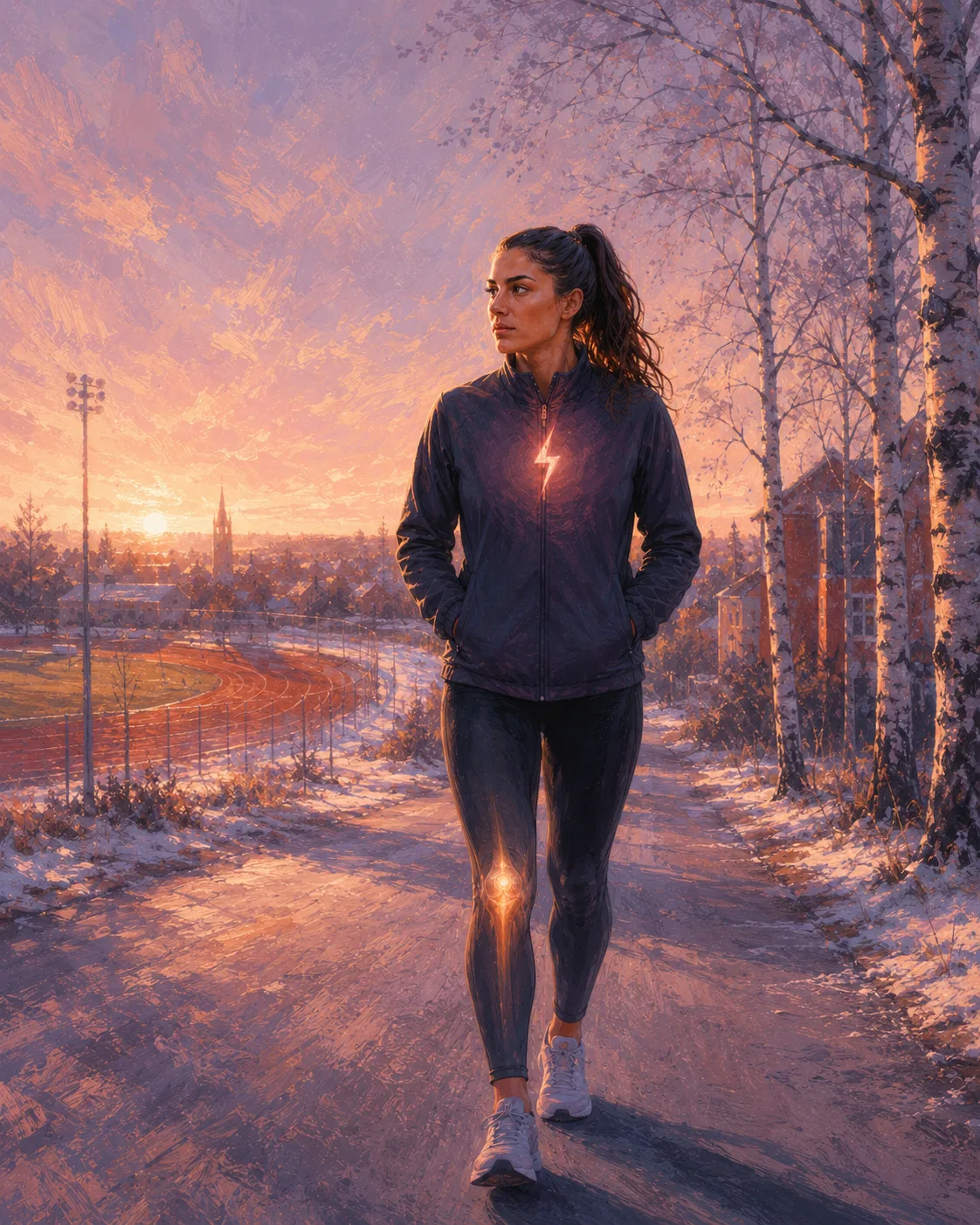
What this story is actually about
It would be easy to read Nooralotta Neziri as a story about resilience — a champion who keeps coming back. That's true, but it misses the more interesting thing she's actually figured out.
What she discovered in 2025 was not how to be tougher. She was already tough. She had been too tough for too long — gritting her teeth through burnout, treating exhaustion as her baseline, sprinting at a body that was begging her to slow down.
What she discovered in 2025 was joy. The simple, almost childlike realisation that sport has to be fun, and that without joy, the hard work doesn't actually produce results.
The ACL tear came eight weeks after the fastest race of her life. It would have been easy to read that as proof that the universe is cruel. She has read it differently. She had nine months — May through August 2025 — to prove to herself, beyond any remaining doubt, that the version of her she'd believed in at 16 was still in there. The race in Espoo wasn't the destination. It was the receipt.
Now she gets to do it all again, and this time she already knows the answer.
She calls herself a Warrior. She isn't being theatrical. She just means:
I have done this before. I will do it again.